5 Classic British Sitcoms That Still Make Us Laugh
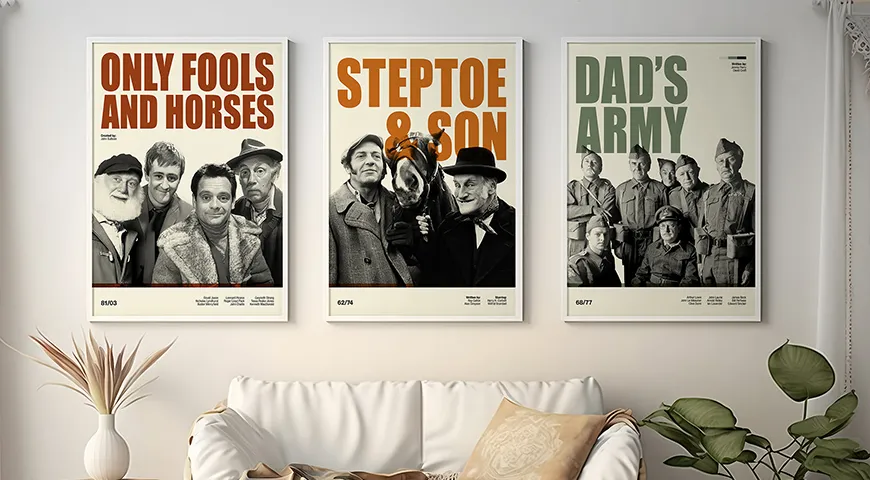
There is something wonderfully enduring about the great British sitcom. Decades after their original broadcast, shows like Fawlty Towers, Only Fools and Horses, and Dad’s Army remain a fixture in our living rooms, streaming queues, and conversations. We quote them at dinner tables, reference them in offices, and find ourselves howling at the same scenes we have watched a dozen times before.
Classic British sitcoms are not merely entertainment, they are a shared language. They capture something deeply human, our snobberies and insecurities, our class anxieties, our warmth, and our bottomless capacity for embarrassing ourselves. That is precisely why the best of them feel as fresh today as they did when they first aired.
In this guide, we celebrate five of the greatest British comedy shows ever made. Whether you are a lifelong fan or discovering these gems for the first time, read on and if you want to bring a little of that magic to your walls, explore our retro TV prints collection at reelretroprints.com
1. Fawlty Towers — Britain's Most Perfect Sitcom
The Brief History
Written by John Cleese and Connie Booth and first broadcast on BBC Two in 1975, Fawlty Towers is arguably the most celebrated British sitcom ever made. Despite comprising just twelve episodes across two series, it achieved a level of critical and popular acclaim that few comedies have matched before or since. In 2000, the British Film Institute ranked it the single greatest British television programme of the twentieth century, no mean feat for a show with fewer episodes than most modern series have in a single run.
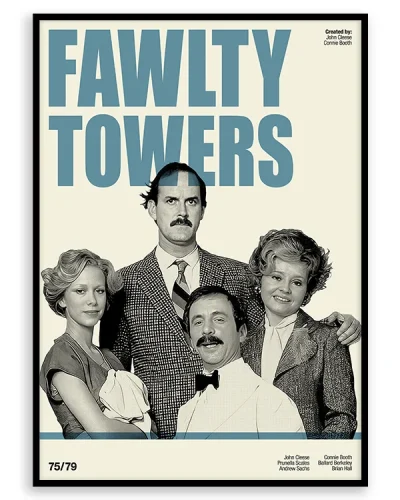
The premise is elegantly simple: Basil Fawlty (John Cleese), a pompous, short-tempered hotelier in Torquay, struggles to maintain his crumbling establishment alongside his formidable wife Sybil (Prunella Scales) and the endlessly patient Spanish waiter Manuel (Andrew Sachs). Each episode builds with the precision of a clockwork farce, a small deception snowballing into spectacular, unstoppable chaos.
Why It Became a Classic
Cleese has spoken of his admiration for the tightly structured farces of writers like Ben Travers, and that influence shows. Every episode of Fawlty Towers is a masterclass in comic construction, misunderstandings pile upon misunderstandings, exits are blocked at precisely the wrong moment, and Basil’s desperate attempts to maintain a veneer of respectability always, inevitably collapse in ruin.
The performances are extraordinary. Cleese’s physical comedy rivals Chaplin, and Sachs’s Manuel became one of the most beloved comic creations in British television history. Iconic moments, Basil thrashing his broken down car with a tree branch, the legendary episode ‘Communication Problems’, the masterpiece that is ‘Gourmet Night’ have entered the national consciousness permanently.
Why It Deserves a Place on Your Wall
Few images in British comedy are as iconic as Basil Fawlty, and a beautifully designed Fawlty Towers print brings that anarchic energy to any room. Perfect for a cinema room, home bar, or as a memorable birthday or Christmas gift for the comedy fan in your life.
2. Steptoe and Son — The Original Odd Couple
The Brief History
Long before sitcoms had learned to carry genuine emotional weight, Steptoe and Son arrived and changed everything. Written by Ray Galton and Alan Simpson, the duo behind Hancock’s Half Hour, the show first aired on BBC One in 1962 and ran until 1974, producing eight series and becoming one of the most influential British comedies ever broadcast.
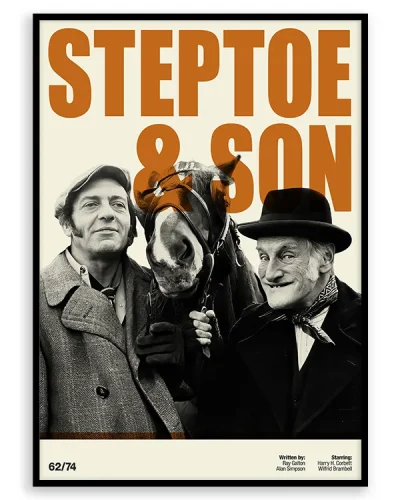
The central dynamic is both hilarious and genuinely poignant: Harold Steptoe (Harry H Corbett), a frustrated, aspirational man who longs for a better life, is perpetually trapped by his manipulative, wheedling father Albert (Wilfrid Brambell) in a grimy rag and bone yard in Shepherd’s Bush. Harold wants to better himself; Albert wants things to stay exactly as they are. The result is a relationship of love and contempt so precisely observed that it feels more like a drama than a comedy.
Why It Became a Classic
Galton and Simpson brought to Steptoe the same gift for melancholy they had shown with Tony Hancock, an ability to find tragedy inside comedy, and vice versa. Harold’s dreams, of opera, of culture, of women who appreciate him, are always just beyond reach, snatched away by Albert’s scheming or by Harold’s own self defeating nature. The show is desperately funny and quietly heartbreaking in equal measure.
Wilfrid Brambell’s Albert became one of the great comic monsters of British television: manipulative, childish, occasionally monstrous, and yet, somehow, utterly loveable. The chemistry between Brambell and Corbett was electric, and their performances remain a benchmark for comic acting.
Why It Deserves a Place on Your Wall
The magnificent slovenliness of Harold and Albert is an image of a vanished Britain that deserve to be celebrated. A Steptoe and Son poster makes a brilliant gift for fans of classic British comedy, particularly for those who appreciate the show’s darker, more complex heart. Ideal for a games room, home office, or man cave.
3. Only Fools and Horses — The Nation's Favourite
The Brief History
If there is a single British sitcom that belongs to everyone, it is the BAFTA award winning Only Fools and Horses. Written by John Sullivan and first broadcast on BBC One in 1981, the show ran for seven series plus a string of Christmas specials and is regularly voted the greatest British sitcom of all time in public polls. Its 1996 Christmas special, in which Del Boy and Rodney finally become millionaires, attracted an audience of over 24 million, one of the largest audiences in British television history.
Set on the Nelson Mandela House estate in Peckham, the show follows Derek ‘Del Boy’ Trotter (David Jason), the eternally optimistic and magnificently deluded market trader, his long suffering younger brother Rodney (Nicholas Lyndhurst), and their grandfather (later replaced by Uncle Albert, played by Buster Merryfield). Del’s catchphrase ‘lovely jubbly’ and his bottomless faith that ‘this time next year we’ll be millionaires’ became national shorthand for a certain kind of cheerful, dogged optimism.
Why It Became a Classic
John Sullivan was a supremely gifted writer with an ear for both comic dialogue and genuine sentiment. Only Fools manages, episode after episode, to be simultaneously hilarious, warm hearted, and genuinely moving. The famous chandelier scene, the Batman and Robin costumes, the bar scene where Del Boy falls through the bar, these are moments of pure comic genius. But the show also had a remarkable emotional range, episodes dealing with loss, loyalty, and love landed with real force.
David Jason’s performance as Del Boy is one of the great comic creations in British television. He is bluster and vulnerability, swagger and tenderness, all at once, a character who should be infuriating but is irresistibly loveable.
Why It Deserves a Place on Your Wall
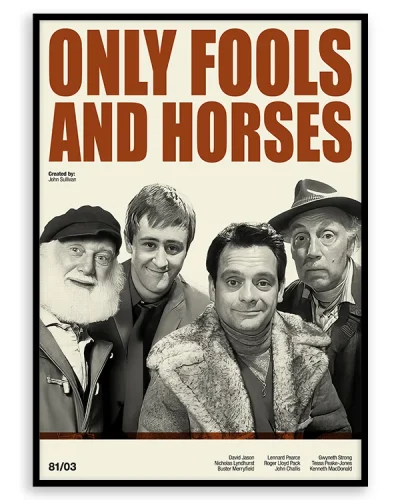
An Only Fools and Horses print featuring the iconic main cast members at their finest is one of those pieces that sparks an instant smile. Perfect for living rooms, man caves, cinema rooms, and as a gift for anyone who grew up with the Trotters. It makes a particularly brilliant Father’s Day present.
4. Dad's Army — Comedy Gold on the Home Front
The Brief History
Created by Jimmy Perry and David Croft and first broadcast on BBC One in 1968, Dad’s Army ran for nine series until 1977, producing 80 episodes that remain among the most watched archive television in Britain. Set in the fictional Sussex coastal town of Walmington-on-Sea during the Second World War, the show follows the hapless but deeply patriotic Home Guard platoon, largely composed of men too old, too young, or too infirm for regular military service, as they prepare (ineffectually) to defend Britain against Nazi invasion.
The ensemble cast was extraordinary: Arthur Lowe as the pompous and magnificently self important Captain Mainwaring, John Le Mesurier as the unflappably languid Sergeant Wilson, Clive Dunn as the ancient and excitable Corporal Jones (‘Don’t panic! Don’t panic!’), Ian Lavender as the permanently terrified Private Pike, and Arnold Ridley as the sweet natured Private Godfrey.
Why It Became a Classic
Dad’s Army works on multiple levels simultaneously. As broad farce, it is irresistibly funny, Mainwaring’s self importance, Jones’s rambling anecdotes, Pike’s haplessness, and Wilson’s beautifully understated scepticism (‘Do you think that’s wise, sir?’) generate comic friction that never grows old. But the show is also, at heart, a genuinely affectionate portrait of a particular kind of British character, stubborn, well meaning, determined, and utterly resistant to the evidence that things are not going to plan.
There is also a quiet melancholy at its heart. These are old men playing at soldiers, many of them veterans of the First World War, doing their modest best in impossible circumstances. The show treats them with warmth and dignity even as it laughs at them, and that generosity of spirit is what has made it endure.
Why It Deserves a Place on Your Wall
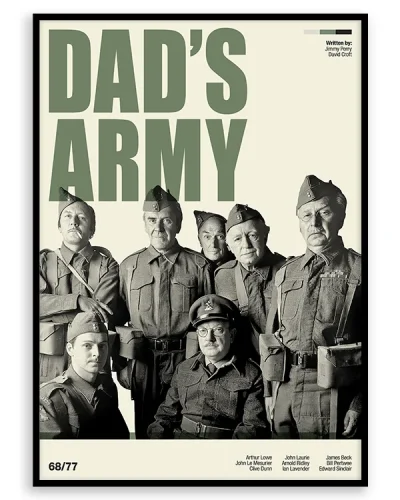
A Dad’s Army art print captures the wonderful absurdity of Mainwaring’s platoon in a way that feels both nostalgic and timeless. These prints make ideal gifts for grandparents, parents, and anyone with a fondness for classic British television, particularly for birthdays, Christmas, or Father’s Day. They look magnificent in a study, home office, or cinema room.
5. Porridge — Behind Bars, Above All Others
The Brief History
Written by Dick Clement and Ian La Frenais and first broadcast on BBC One in 1974, Porridge starred Ronnie Barker as Norman Stanley Fletcher, a habitual but fundamentally decent petty criminal serving time in the fictional HM Prison Slade in Cumbria. Running for three series until 1977, plus a follow up series, Going Straight, and a feature film, Porridge is consistently ranked among the greatest British sitcoms ever made.
Fletcher’s cellmate is Lennie Godber (Richard Beckinsale), a naive young first time offender whom Fletcher takes under his wing. The show’s warmth derives largely from this central friendship, Fletcher, beneath his cynical exterior, is a genuinely moral man who looks out for those weaker than himself. His ongoing battle of wits with the dour Governor Mr Barrowclough and the bullying Mr Mackay (Fulton Mackay) provides the comic engine.
Why It Became a Classic
Porridge is remarkable for the depth of characterisation it achieves within what might seem a limiting premise. Fletcher is no simple rogue, he is principled within his own code, loyal, clever, and, when the script demands it, capable of genuine pathos. Ronnie Barker’s performance is one of the greatest in British comedy, his timing was faultless and his range extraordinary.
Clement and La Frenais were equally gifted at writing comic dialogue and moments of genuine feeling, and Porridge balances these perfectly. The prison setting, which might seem uniformly grim, is rendered with wit and humanity, and the supporting cast, including the wonderful Brian Wilde as the ineffectual Mr Barrowclough, are uniformly excellent.
Why It Deserves a Place on Your Wall
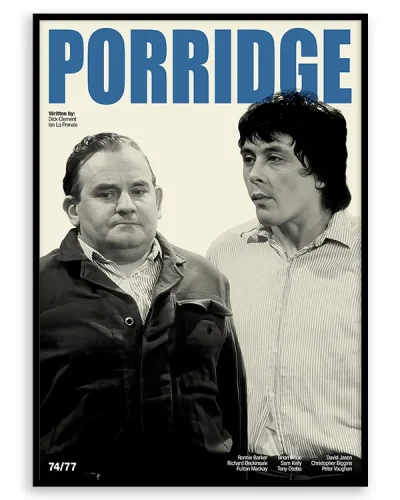
Fletcher’s knowing expression, his prison uniform, and his cellmate Godber, rendered in a bold retro print style, make for a piece of wall art that any comedy lover will treasure. Browse our Porridge print and give the gift of a genuine British classic. These prints work beautifully in a home bar, games room, or cinema room, and make a wonderful housewarming gift for anyone with a taste for golden age British comedy.
Bring British Comedy Classics to Your Walls
Classic British sitcoms are more than television, they are part of the cultural fabric of these islands. They make us laugh, yes, but they also make us recognise ourselves: our pretensions, our kindness, our stubborn optimism, and our talent for getting into situations from which there appears to be absolutely no dignified way out.
At ReelRetroPrints.com, we celebrate that legacy with a range of beautifully designed British TV prints that bring these iconic shows to life as genuine pieces of wall art. Whether you are looking for a gift for a devoted comedy fan, a nostalgic piece for your own home, or something special for a cinema room or man cave, our collection has something to delight every taste.
Explore the full range of retro TV prints and find the perfect piece of British comedy history for your walls today.
Frequently Asked Questions
What is the greatest British sitcom of all time?
This is a gloriously contentious question. Public polls consistently place Only Fools and Horses at the top, while critics often favour Fawlty Towers, ranked number one by the British Film Institute. Porridge, Steptoe and Son, Dad’s Army, and Blackadder all feature regularly in the top ten of any serious list. The honest answer is that there is no single answer, which is precisely why the debate is so much fun.
Why is Fawlty Towers considered a classic?
Fawlty Towers is celebrated for its extraordinary comic precision. Each of its twelve episodes is constructed with the rigour of a stage farce: a snowballing misunderstanding, perfectly timed exits and entrances, and a catastrophic climax. John Cleese’s performance as Basil is a masterclass in physical and verbal comedy, and the show’s writing, co-authored with Connie Booth, has never been bettered in the sitcom form.
Which British sitcom has the most episodes?
Last of the Summer Wine, written by Roy Clarke and broadcast on the BBC from 1973 to 2010, produced a remarkable 295 episodes across 31 series, making it the longest running British sitcom and one of the longest running sitcoms in the world. For sheer volume of beloved episodes, however, Only Fools and Horses, with its seven series and many Christmas specials, provides more concentrated comedy gold.
Are classic British sitcoms still popular?
Enormously so. Fawlty Towers, Only Fools and Horses, Dad’s Army, and Porridge all remain available on BBC iPlayer and streaming platforms, and continue to attract significant audiences. Gold and other digital channels repeat classic British comedy shows to consistently healthy ratings. New audiences discover them constantly, and the shows have found devoted followings internationally, particularly in Australia, New Zealand, and parts of Europe.
Where can I buy British sitcom wall art?
ReelRetroPrints.com offers a curated range of British TV prints featuring classic British sitcoms including Fawlty Towers, Only Fools and Horses, Dad’s Army, Steptoe and Son, and Porridge. Each print is designed in a bold retro style that celebrates the golden age of British television. They make perfect gifts and look wonderful as framed wall art in living rooms, cinema rooms, home offices, and man caves.
What makes retro TV prints a great gift?
Retro TV prints work beautifully as gifts because they combine a shared cultural reference, something the recipient genuinely loves, with a piece of design that has real visual impact on a wall. Unlike generic gifts, a print of a beloved sitcom tells the recipient that you know them well enough to choose something meaningful. They are ideal for Father’s Day, birthdays, Christmas, and housewarming gifts, and because they are timeless, they never go out of fashion.